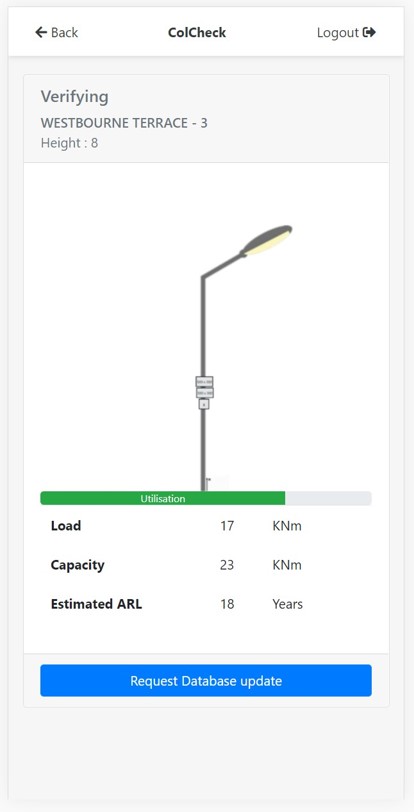
Description
In order to demonstrate compliance with Guidance Note 22 (GN22), the latest national guidance from the Institute of Lighting Professionals (ILP) on treating lighting columns as ‘Minor Structures’, Westminster’s street lighting team wanted to understand the extent to which attachments have been added to the council’s stock of street lighting columns, and the impact they might have on the structural integrity of their lighting column stock.
Westminster intends to inspect all column attachments and gather essential information on their remaining capacity, as they previously lack any data regarding these attachments. Sustainovel via Free4m to develop a computerised methodology to determine the load carrying capacity of a column quickly and simply, and assess any reduction in the load carrying capacity of a column from any attachments. Furthermore, the council wanted to understand the estimated residual capacity in any column so that it could make decisions on requests for further attachments and whether this could be permitted without compromising the integrity of the column.
Our Solutions
Sustainovel via Free4m executed a LiDAR survey of their highway network initially with purpose of identifying attachments to their lighting columns using Artificial Intelligence (AI) technology. The LiDAR survey effectively gives Westminster a ‘digital twin’ of its network, a snap-shot in time on the day of the survey. Having an understanding what attachments exist on the council’s lighting column assets, along with the condition of the columns and basic column information such as column height, material type and thickness etc. and with the application of structural mechanics, the council wanted to assess the Assumed Residual Life (ARL) of its columns.
Subsequently, Westminster council opted to utilize this technology for identifying additional urban assets. So Sustainovel via Free4m used its own in-house team to write the AI to detect the various objects . The AI asset detection platform used for Westminster is particularly suitable for urban asset management purposes, it is easily adapted to define and detect new object types. Information is stored in a secure centralised database, information provided is also GDPR compliant. As a result, more than 40 types of urban assets were identified and their information was stored in the database.
The application of AI to then detect objects e.g. lighting columns, signs, bollards, benches etc. from the survey, provided an automated process to detect over 50,000 assets including their accurate geolocation. Furthermore, using Virtual Reality (VR) goggles, it was possible to manually check the quality of the survey data and also to check the AI had not missed detection some assets. The AI technology requires enough light contrast between the object being detected and its background, so for example a black bollard may not be picked up if the background is a black garage door. The VR goggles were used to make these manual checks to provide high levels of confidence of asset detection.
A third party company audited our results And was confirmed that the accuracy of our data was 95%.